Sign In
Upcoming Event
 Free Newsletter

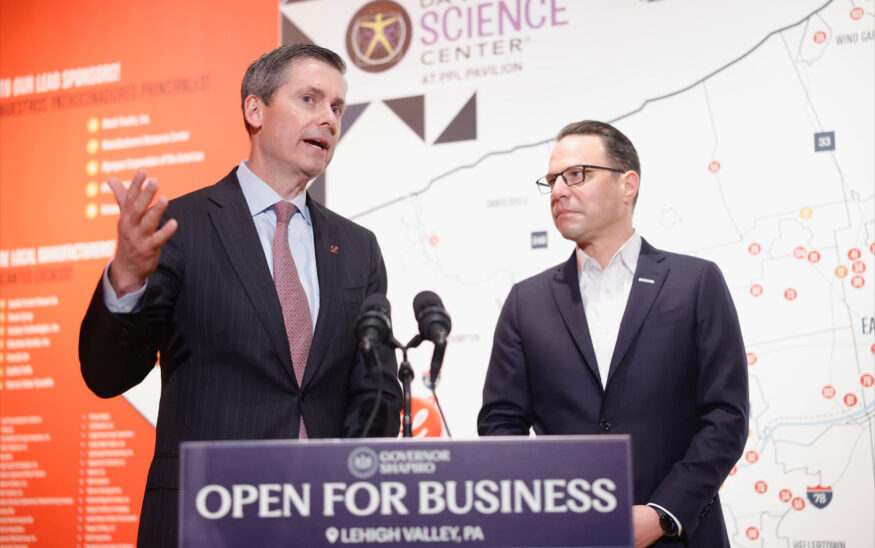
Eli Lilly Chair and CEO David Ricks talks with Pennsylvania Gov. Josh Shapiro during the announcement that Lilly would be investing $3.5 billion to bring a GLP-3 manufacturing facility to the Lehigh Valley. PHOTO/PA CAST
Lehigh Valley braces for $3.5B pharmaceutical manufacturing plans
Stacy Wescoe//February 9, 2026//


Local economic development, education and business leaders are still wrapping their heads around the scope of the news they received Jan. 30 when Eli Lily chair and CEO Rick Davis, came to Allentown to announce that his pharmaceutical manufacturing company was investing $3.5 billion to bring a seven-building state-of-the-art manufacturing facility to Upper Macungie Township. When built, the facility will produce the latest generation of GLP-3 medications, which are designed to help people lose weight.
Lehigh Valley elected officials are singing the praises of the news.
Senator Nick Miller, D-Allentown, called it a defining moment for the region and state’s future.
“This transformative project will create hundreds of family sustaining, skilled jobs while reinforcing the Lehigh Valley’s reputation as a premier destination for advanced manufacturing and life sciences innovation,” Miller said.
Josh Seigel, Lehigh County executive called the project, “a once in a generation investment.”
Describing it as the single biggest economic development investment in the Lehigh Valley ever, Don Cunningham, executive director of the Lehigh Valley Economic Development Corporation, said the news should mean more than 850 jobs at the company, most of which Davis said will earn in the neighborhood of $100,000 per year.
But the facility will be built from scratch using local talent, and he expects that should create about another 2,500 construction jobs to help make the campus a reality.
He said a lot of work was done to lure Eli Lilly to the Lehigh Valley. The LVEDC and state economic development officials worked for about 24 months to develop marketing and incentive packages to draw the pharmaceutical company to the Lehigh Valley.
The site is one of four Eli Lilly is building in the U.S. in an effort to onshore its pharmaceutical production. And rebuild America’ pharmaceutical industry.
The Lehigh Valley, actually missed out on the first site, but he said the LVEDC and state economic development officials wouldn’t give up on luring the company to the region.
But Ricks said getting just one of the four proposed sites was a huge win for the Lehigh Valley, noting that the company received more than 300 proposals for metropolitan areas seeking to be one of the sites.
“Lehigh Valley was one of four, for what you could call a highly competitive process,” Ricks said.
Cunningham gave a great deal of credit to the state for the work they did to put together a funding package that would attract such a big investment.
Governor Shapiro said the state is investing $100 million to support the manufacturing site project in the Lehigh Valley, noting that Pennsylvania competed aggressively against other states to win the project.
“When we announced our Economic Development Strategy here in the Lehigh Valley two years ago, we set out to win historic, life-changing deals like the one we’re announcing with Lilly today,” said Shapiro. “Lilly’s commitment to the Lehigh Valley and to Pennsylvania will bring billions of dollars of investment and hundreds of good-paying jobs, solidifying our position as a leader in the growing life sciences industry.”
Lilly received a funding proposal from DCED for up to $50 million in tax credits through the PA Edge Tax Credit Program, a $25 million grant through the PA SITES (Pennsylvania Strategic Investments to Enhance Sites) Program, and a $25 million Pennsylvania First grant. The state has also committed to providing a Redevelopment Assistance Capital Program (RACP) award of up to $5 million to a local community college and/or technical school to help create a workforce development training program that would serve as a talent pipeline for the company in the Lehigh Valley.
Shapiro noted that this will be the first Lilly manufacturing facility in Pennsylvania and said it represents a long-term commitment to the state from one of the world’s leading drugmakers.
Lilly has said it expects the facility to be complete in 2031, but both the state and local economic development officials said they want to help the manufacturer with expedited permitting and approvals that were outlined in a recent state budget to boost job creation, so they hope the timeframe will be much less.
Lilly is receiving assistance through Pennsylvania’s Office of Transformation and Opportunity (OTO) on the project via the PA Permit Fast Track Program, which was designed to streamline the state’s permitting process for key economic development to accelerate timelines to ensure state government delivers results quickly and efficiently.
With just a few years or so to bring what is mostly an entirely new high-tech manufacturing process to the region, education is key, which was what inspired the $5 being invested to help local educators create a workforce development training program that will meet Lllly’s specific needs.
Ann Bieber, president of Lehigh Carbon Community College, said her school will be a leading force in that effort, which she called an exciting opportunity.
“Partnering with Eli Lilly is a natural extension of LCCC’s commitment to the community. This $5 million grant allows us to create a unique, specialized curriculum specifically for the bio-pharma sector,” Bieber said. “From lab testers to quality assurance technicians, we are carving out clear pathways to careers that offer both stability and the chance to contribute to life-saving medical advancements.”
And Ricks said that Lehigh Valley residents should understand that life-saving work will be done here.
He noted that the GLP-3 injectables that will be manufactured in Upper Macungie Township will help people with obesity fight the condition that can lead to up to 200 other life-threatening conditions.
And these medications, he said, won’t just be helping people in the region or even around the country, but will be shipped globally to help fight the obesity epidemic around the world.