Sign In
Upcoming Event
 Free Newsletter


PHOTO/GETTY IMAGES
Pennsylvania needs investment for economic growth
Cris Collingwood//March 15, 2024//


 Listen to this article
Pennsylvania is among the top states in the nation to receive research dollars but 48th in converting those funds into new business.
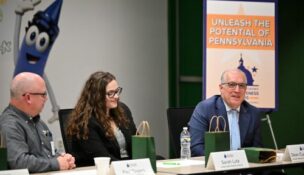
“Per capita, the Dakotas are beating us,” Jen Gilburg, deputy secretary of Technology and Entrepreneurship for the state Department of Community and Economic Development, told members of the Lancaster Chamber of Commerce Thursday morning.
“The only two that aren’t beating us are West Virginia and Arkansas,” she quipped.
To do better, Gilburg suggested the research higher education institutions are doing needs to shift from publishing papers to starting companies.
“We need leaders who take ideas and raise capital to create great companies,” she said.
Gilburg, who said it has been 20 years since the state had a formal economic development plan, told the group of about 60 local business owners and community leaders, the economic numbers are “underwhelming.”
“We should do better,” she said.
Gilburg, who works under DCED Secretary Rick Siger, said the goals of the Pennsylvania Economic Development Strategy are to invest in economic growth, innovate to win, make government work at the speed of business and open more doors of opportunity.
“If we are going to have growth, we have to invest,” she said, adding industries like life sciences, renewables and AI are where the state needs to focus to attract and keep young workers.
To help grow the sectors identified by the Shapiro Administration, Gilburg said Ben Kirschner, chief transformation and opportunity officer has already reduced the time it takes to get a new business permit from seven weeks to about three days.
“And he’s working to get it down to one day,” she said. “He’s working to make things more frictionless and work at the speed of business.”
Like Lancaster County, Gilburg said the state 10-year economic plan identifies five areas as real opportunities for growth. They are agriculture, energy, life sciences, manufacturing, and robotics and technology.
“In his budget, Gov. Josh Shapiro proposed $600 million for new investments,” she said. “These are critical investments.”
The investments include fixing education and the 500 million brownfield sites across the state.
Ezra Rothman, president of EDC Lancaster County, who said he is excited by the governor’s new plan, said Lancaster County has very few industrial sites available and many that are have “significant” issues.
Companies looking to grow or locate in the area are hit with increased costs when faced with contaminated land, he said.
“In 2022, Lancaster County saw economic growth of 36.4%,” he said, with the highest growth in manufacturing, professional and business services, and health care and social assistance.
While the health care and social assistance employed the most people in the county in 2022 at 17.3%, Rothman said manufacturing came in a close second with 16.7% and is growing.
With that growth comes the need for land, he said. Lancaster County is zoned 70% agricultural and 3% industrial so remediation is necessary to prepare sites to continue to attract business.
The manufacturing GDP for 2022 was 17% while health care and social assistance was 9.9%, he said.
In addition to the need for land, Rothman said, the county needs to attract and retain younger workers as the population is aging, especially in the manufacturing sector.
“The share of the Lancaster population aged 55+ increased 9.7% from 2000 to 2020,” he said.
In fact, 26% of full-time workers are 55+ and aging out.
“We are going to see a lot of experience aging out, especially in manufacturing,” he said. “We need new tech jobs to excite people to come here so we can grow.”