Sign In
Upcoming Event
 Free Newsletter

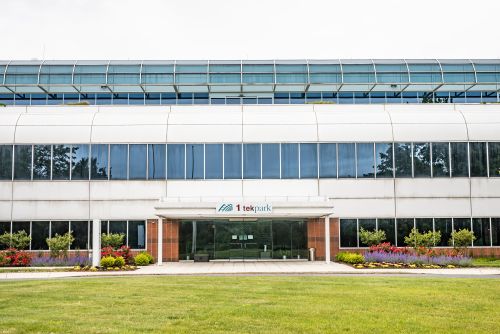
TierPoint is expanding its Tek Park data center in Upper Macungie Township, adding up to 100 jobs and launching a 100-megawatt expansion after a $175M purchase. PHOTO/LVEDC
Planning needed for potential Lehigh Valley data center boom
Stacy Wescoe//January 14, 2026//


 Listen to this article
There’s no doubt that the use of Artificial Intelligence (AI) has been growing in recent years.
And it’s not just people asking ChatGPT to show them what they would like as a potato, or students looking for a little “extra-curricular” help on their homework.
Most industries are now employing AI in some way, from helping to track data, to hiring and financial management.
The demand for AI is only expected to grow, and with that the data centers needed to support them.
But these data centers, while bringing large investments into the communities they locate in as tech companies spend billions in a race to expand the technology, their operation does come at a price.
That price comes in land, power, and infrastructure.
Research from the Pew Research Center shows that U.S. data centers consumed 183 terawatt-hours of electricity in 2024, according to International Energy Agency (IEA) estimates.
Pew said that means that in 2024 it took up more than 4% of the country’s total electricity consumption last year. By 2030, that’s projected to grow by 133% to 426 TWh.
While data centers come in all shapes and sizes, Pew found that a typical AI-focused hyperscaler annually consumes as much electricity as 100,000 households.
There are currently larger such facilities under construction that are expected to use 20 times as much, the IEA predicts.
With the Lehigh Valley becoming a popular destination for such data centers because of its central location in the Northeast U.S., the Lehigh Valley Planning Commission has been working with tech interests and municipalities to make sure that any data center projects coming to the Lehigh Valley are a right fit for the community, providing jobs without stripping the region of vital resources.
Becky Bradley, executive director of the Lehigh Valley Planning Commission, said large data centers are coming, and have replaced warehouses and logistics facilities as the biggest developer of industrial space in Lehigh and Northampton Counties.
And their presence will be significant. She noted that three of the proposals being considered in the region are more than 2 million square feet in size – with one considering more than 5 million square feet.
That’s a big difference, she said, considering that even the largest warehouses in the Lehigh Valley are generally no more than 1 million square feet.
Among some of the notable projects being considered locally is a proposal for the Atlas Industrial data center, which reportedly could include six buildings and an electric substation.
It would total about 5.1 million square feet in South Whitehall Township accross from Parkland High School.
Air Products has currently paused plans to bring a 2.6 million-square-foot data center in Upper Macungie.
A St. Louis-based data center company, Teir Point, plans a 100-megawatt expansion of the data center, on the site of Tek Park’s 137-acre campus it recently purchased in Upper Macungie Township.
According to the LVEDC, it’s the largest by total power capacity of its portfolio of centers in more than 20 markets.
But, she added that to properly plan for the impact that such centers could have, regional municipalities need to have the latest information about the benefits and needs of such facilities.
“In the last year we updated data centers new land use categories,” said Bradley.
She noted that since the 2024 statistics on power use, data centers have worked to become more efficient, both for their own profitability and to make them more sustainable.
“Data centers are evolving quickly, and newer ones aren’t sucking up water for cooling and dumping it into sewers like some of the older ones,” Bradley said. “They’re becoming more efficient. The question is what effect will it have on a community and how will we mitigate that?”
She said rather than being reactive, planners and municipalities need to work with data center developers to make sure that they are addressing issues of consistent development quality and manage expectations.
“The big warehouse boom at its worst felt like the wild west and it caused a lot of anxiety. No one wants that to happen again, so there’s been a very concerted effort – how do we plan for this to make sense?” she said.