Sign In
Upcoming Event
 Free Newsletter


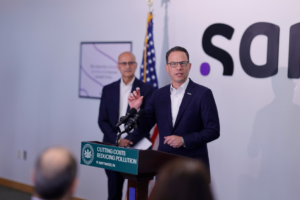
Governor Josh Shapiro is urging the Senate to pass the new minimum wage legislation. PHOTO/PACAST
Shapiro’s budget proposals draw mixed reviews
Ed Gruver//February 4, 2026//


 Listen to this article
- Shapiro budget emphasizes cutting costs, growing the economy, strengthening public safety, and funding education
- Senate Republicans say the proposal spends too much money without protecting Pennsylvania‘s future fiscal stability.
- Proposal draws praise, criticism across commonwealth
Governor Josh Shapiro presented his 2026-27 budget proposal to a joint session of the General Assembly, emphasizing cutting costs, growing the economy, strengthening public safety, and funding education.
“This budget builds on the progress we’ve made by making smart, responsible investments that strengthen our schools, keep communities safe, and grow our economy,” Shapiro said in his address. “At a time when dysfunction and division seem to dominate elsewhere, here in Pennsylvania we’ve shown that we can still work together to get stuff done and build on what’s working — because Pennsylvania is on the rise.”
Reaction from across the commonwealth was varied.
Pennsylvania Chamber of Business and Industry President & CEO Luke Bernstein called the governor’s budget address the first step in a long and important process.
“As this process advances, we remain focused on proposals that improve Pennsylvania’s ability to increase and attract investment, create jobs, and grow our economy. Our collective goal should be to make Pennsylvania the best state in the country to do business,” said Bernstein.
“Recent bipartisan efforts have advanced our competitiveness through tax reforms, improved permitting, encouraging energy generation, and workforce initiatives that help employers find and train talent. These results demonstrate what is possible when the administration and General Assembly prioritize making Pennsylvania a stronger environment for business growth.”
Bernstein noted that while Pennsylvania has made meaningful progress in many key areas, other states are also working aggressively to attract jobs and investment.
“As the budget process moves forward, we urge caution against measures that would undermine our competitiveness — like adding complexity to our tax laws, creating new barriers to investment, committing the commonwealth to unsustainable spending, and government overreach into the private sector.”
Senate Majority Leader Joe Pittman (R-Armstrong/Indiana/Jefferson/Westmoreland) said the budget proposal spends too much money without protecting Pennsylvania’s future fiscal stability.
“As we begin our work on this year’s budget, looking for more government efficiencies and respecting taxpayers by controlling the growth of state spending are key priorities of our Senate Republican Caucus,” said Pittman.
Union Energy applauded the budget’s focus on workforce development and energy initiatives.
“Governor Shapiro’s budget proposal demonstrates a clear understanding of the issues facing workers and the environmental needs of the commonwealth,” said Angela Ferritto, president, Union Energy. “From increased investments in education and apprenticeship programs, to critical programs that cap abandoned wells and improve infrastructure, the governor understands the need for skilled labor that protects the health and safety of all Pennsylvanians.”
Ray Murphy, co-leader of Pennsylvanians for Accountability from Yass, Billionaires and Corporations (PAYBAC) which leads the Tax Billionaires, Fund PA campaign, said revenue from billionaires and corporations could close the $5 billion gap.
“The federal ‘Big Beautiful Bill’ creates a multi-billion dollar hole in the budget,” said Murphy. “While the governor acknowledged the need to shore up essential programs threatened by federal cuts, we’re disappointed he didn’t tap into the substantial revenue available from Pennsylvania’s wealthiest corporations and billionaires, which could solve the $5 billion per year hole and protect lifeline programs like healthcare and food access that are being gutted by the federal budget bill.”
The Pennsylvania Workforce Development Association (PWDA) welcomed the budget’s focus on workforce development.
“More and more Pennsylvanians are seeking new pathways to build a good career and a good life in Pennsylvania,” the PWDA said. “Continued investment in apprenticeships, career and technical education, and workforce development will help job seekers, students, and workers get the skills they need in their communities. These investments will help businesses get the workers they need to grow and thrive.”
The principal partners of Early Learning Pennsylvania (ELPA), a statewide coalition of advocates focused on supporting young Pennsylvanians from birth to age five, expressed appreciation for the budget’s focus on children and early education workforce investments.
“Start Strong PA applauds Governor Shapiro for continuing to prioritize the child care workforce by building on the $25 million recurring Child Care Recruitment and Retention Program funding with an additional $10 million investment,” ELPA stated. “These funds will support programs as they work to recruit quality applicants and retain experienced educators.”
President and CEO Andy Tubbs of the Energy Association of Pennsylvania (EAP), which represents the commonwealth’s electric and natural gas distribution utilities, said EAP supports a comprehensive effort to address energy affordability for customers and to protect the economic development role electric distribution companies play in Pennsylvania.
“We have some fundamental disagreements with the governor, but we stand ready to work with his administration, legislative leaders and all stakeholders on comprehensive solutions that maintain reliability, support Pennsylvania jobs, attract economic development and result in reasonable rates for all customers,” EAP said.
Angela Ferritto, president, Pennsylvania AFL-CIO, noted that from initiatives and investments in child care and public education to housing and energy affordability, this budget includes investments that help working families advance.
“At a time when affordability is top of mind for PA working families, increasing the minimum wage to $15 per hour ensures workers can make a wage worth working for—a necessary increase after 15 years of stagnation that would result in fewer families needing to rely on safety-net programs.”
The PA Literacy Coalition noted the proposal’s significant investments in K-12 and early childhood education.
“However, by omitting funding for early literacy, the proposal misses the opportunity to double down on the commonwealth’s recent bipartisan commitments to evidence-based reading instruction and to advance Pennsylvania toward national leadership in literacy,” said the PA Literacy Coalition.
Teach Plus praised proposed Investments in adequacy funding and student teacher stipends.
“In response to the Commonwealth Court’s ruling that Pennsylvania schools are unconstitutionally funded, Governor Shapiro has met the moment with true leadership and commitment,” said Laura Boyce, Pennsylvania Executive Director of Teach Plus. “By staying the course with continued investments until the full adequacy gap is closed, the governor is making good on his commitment to fully fund our public schools and bring real opportunity to kids in Pennsylvania.”
The Pennsylvania Homecare Association (PHA) expressed disappointment that the budget proposal does not address the funding shortfalls facing home-based care, leaving Pennsylvania without the support needed to stabilize access for seniors, adults with disabilities and medically fragile children who rely on care at home.
“Access to care at home is already severely strained for families in every region of Pennsylvania,” said PHA CEO Mia Haney. “This budget does not respond to the reality providers, workers, and care recipients are facing today, and that is deeply concerning.”