Sign In
Upcoming Event
 Free Newsletter


Eric Robuck, CEO, Valander Cybersecurity. Dave Myers, executive director, Berks Alliance. Laura Cibulsky, O’Pake. Caitlin Long, O'Pake, and Justin Loose, CIO at Threshold Rehabilitation discuss potential areas of collaboration in the biotech space. PHOTO/SARAH MATARELLA, ALVERNIA UNIVERSITY.
Berks collaborative aims to grow life science industry in county
Cris Collingwood//August 12, 2024//


 Listen to this article
A collaboration born out of COVID is working to grow life science businesses in Berks County.
The Berks Biomedical Innovative Collaborative (BIC), which has invested more than $100 million into the local economy to date, is focused on growing the life science, medical, biotechnology, and pharmaceuticals industries, according to Caitlin Long, director of Technology Transfer & Innovation Commercialization for O’Pake Institute for Economic Development & Entrepreneurship and BIC managing director.
Partners include area higher education institutions, medical institutions, life science companies, venture investors and related professionals.
Rodney Ridley, vice president of Research, Innovation & Economic Development, Alvernia University, COO of O’Pake Institute, and BIC chair, said the idea got started when representatives from Tower Health reached out to O’Pake Institute to see how physicians who created ways to save COVID patients could share their ideas with others.
“They had ideas and wanted to know how to commercial them. We do that,” he said. “We don’t do clinical trials so we asked them if, when we get commercialization, will you do the trials. That’s how this started.”
Berks County has a strong presence in the medical industry, Ridley said. There is a lot of manufacturing of medical devices and the county is close to others in the Philadelphia market, making Berks County ideal for growing the industry, said Laura Cibulsky, PhD graduate assistant of Biomedical Innovation, O’Pake.
“There are a lot of pieces to this that were never brought together,” Ridley said. “We even have two medical schools in Reading so there is a lot of support for medical activity.”
The idea, which started with Tower Health and Alvernia, grew to include input from Ben Franklin Technology Partners for guidance, Ridley said.
Kimberly Valuntas, Ben Franklin TechVentures Portfolio manager, said Ben Franklin got involved in the collaborative in 2022 because “our missions align.”
While the collaborative is relatively new, Valuntas said the number of people sitting at the meetings has increased greatly and everyone is bringing something to the table.
“As Caitlin (Long) came in with her background, things really took off,” Ridley said.
Long said the BIC initiatives include incubation and acceleration of startup companies, innovation to industry, and health equity.
For the health equity piece, BIC looks for projects which will give back to local, underserved communities and improve health outcomes, she said. One local company BIC helped is CatapalloVR, a business-to-business software service company that offers virtual platforms to service providers to help both children and adults learn new skills to navigate life.
“We were able to get the company off the ground,” Ridley said. “She (Kryn McClain) was incubated here, and we offered her technical services through the help of Penn State’s Lehigh Valley LaunchBox and Ben Franklin. We wrap our arms around to assist here.”
Ridley said BIC has helped a dozen life sciences companies at various stages of development get to market in its two years of becoming a formal entity.
“The challenge is these companies need a place to grow,” Ridley said. “So, we are looking at creating incubators. It’s a ‘If you build it, they will come’ thing. Right now, we work with most companies where they are.”
Ridley said BIC is looking at a potential site in downtown Reading. The 90,000 square foot former optical facility would be perfect as BIC could ramp it up in stages as the need arises.
“We would love for Ben Franklin to be part of it. They have been very successful in taking companies from product formation to manufacturing to a full company,” Ridley said.
With a Life Science and Healthcare Fund already in place, Ben Franklin is poised to help companies get started or grow. The fund offers up to $250,000 to match funds from partners to develop new biologies, medical devices or diagnostics, in-hospital staff and patient safety and community health solutions, according to the Ben Franklin website.
Community partners must commit at least $50,000.
“This was pretty new when we joined,” Valuntas said. “There is a lot of health care organizations in Berks County so (the collaborative) is bringing together partners to grow the industry.”
Valuntas said Ben Franklin’s part is to help create and retain jobs.
“The goal is to further ideas and products for existing companies and help new companies grow,” she said, adding the lower cost to do business in Berks County compared to the Philadelphia market and the potential return of rail service make the area ideal to attract companies.
BIC is also working with the state Department of Community and Economic Development to secure funding to help get the incubator off the ground, Ridley said.
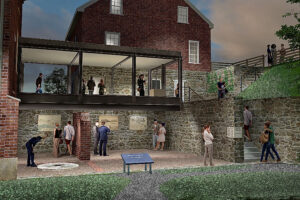
“We have a local architectural firm that volunteered to create vision boards for the property. Now we have to raise the money,” Ridley said.
Cibulsky said when working with life sciences companies, they need lab space to move ideas to the next level.
“The companies are looking at 1,500 square feet for chemical processing to solidify their product,” she said. “Once they get enough customers, they can move into their own space.”
More than 24 organizations have joined BIC because, Ridley said, they all see the big picture of making biomedical work in the area.
Together, Ridley said BIC will provide all the services startup companies need to grow and established companies to expand.
“We can also offer technical services for students who want to learn,” he added.
“We think of this as an emergency department,” Ridley said of BIC’s base at O’Pake. “We treat the issues here and then triage them to other companies and organizations where needed.”
BIC is planning a symposium Jan. 12 at the Double Tree by Hilton Hotel, 701 Penn St., to showcase its efforts, Ridley said.