Sign In
Upcoming Event
 Free Newsletter

LCCC: Training needed to meet the demand growing demand for data center development
Stacy Wescoe//January 27, 2026

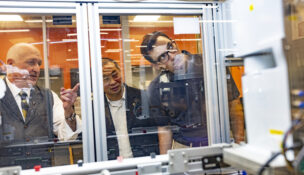
Training can be held on site at an employer’s campus using LCCC’s mobile advanced manufacturing lab. PHOTO/LCCC
LCCC: Training needed to meet the demand growing demand for data center development
Stacy Wescoe//January 27, 2026//


There’s been a great deal of talk about the data center boom that is expected in the Lehigh Valley that will help evolve the future of technology.
But before the technology revolution can begin – someone needs to build them – and that means a skilled workforce is needed to meet the demand.
Lehigh Carbon Community College is part of that effort. It was one of fourlocal community colleges, along with Northampton, Bucks and Luzerne chosen to partner on a Technology and Trades Workforce Consortium in the Northeast Region of Pennsylvania.
The partnership comes from the June announcement that Amazon was planning to invest at least $20 billion to establish multiple high-tech cloud computing and artificial intelligence (AI) innovation campuses across Pennsylvania, creating at least 1,250 high-paying, high-tech jobs.
Ann Bieber, president of Lehigh Carbon Community College, said the big need right now for the development of these data centers is for skilled electricians.
“We are so honored to advance Pennsylvania in economic development, workforce development, and even quality of life,” said Bieber. “The community college sector is pleased to serve in this capacity.”
She said LCCC has been working with the local electrician’s union, IBEW Local 375 and the Workforce Board Lehigh Valley to recruit and train electricians that can build out the infrastructure for these data centers and keep them running.
Bieber said the Amazon Web Services project is just one of many that the region is expecting.
“Other data centers also have needs. This will benefit many industries and people seeking employment,” Bieber said.
She said those in the industry that she’s been speaking to, including AWS, have made it clear that they want to hire local workers rather than bringing in electricians from outside of the area, that means many more skilled workers are going to be needed in the near future.
But Bieber said LCCC and the other community colleges in the region are ready for the task. The workforce education industry has already been adapting to the modern needs of both those seeking education and those industries needing workers with specific skills.
She said one of the changes community colleges have seen in recent years has been the trend away from students entering the school with the direct aim of obtaining an associate’s degree.
Instead, she said schools are developing modules and stackable certifications that can be incremental steps along a path toward a degree, but with short-term, actionable skills attainment.
Bieber said some of that comes from the demand from employers. She gave the example of the advanced manufacturing training that LCCC offers. Most of them were offered in 12-week programs, but the school has been approached by some employers asking if those could be made more efficient so that training can be completed in nine weeks.
One way that LCCC has been trying to make training more efficient for companies is by offering mobile manufacturing labs.
The community college currently has three mobile training units, a significant investment considering they cost about $500,000 each.
These units can be located at an employer that needs specific training for its staff, or at other convenient locations for students, which Bieber said can be a great help for employees and employers.
“They don’t lose the downtime for employees to drive to the college,” she said.
And it’s not just electricians, Bieber said. There is a wide variety of training in advanced manufacturing and upskilling.
Other trades, such as construction, also need to develop the skills needed to meet the future demands of the new or growing employers in the region.
“We need to be quicker, faster. This is a great benefit to the community,” Bieber said.