Sign In
Upcoming Event
 Free Newsletter

Temple University working with Quakertown manufacturer to improve robotic manufacturing
Stacy Wescoe//August 18, 2026
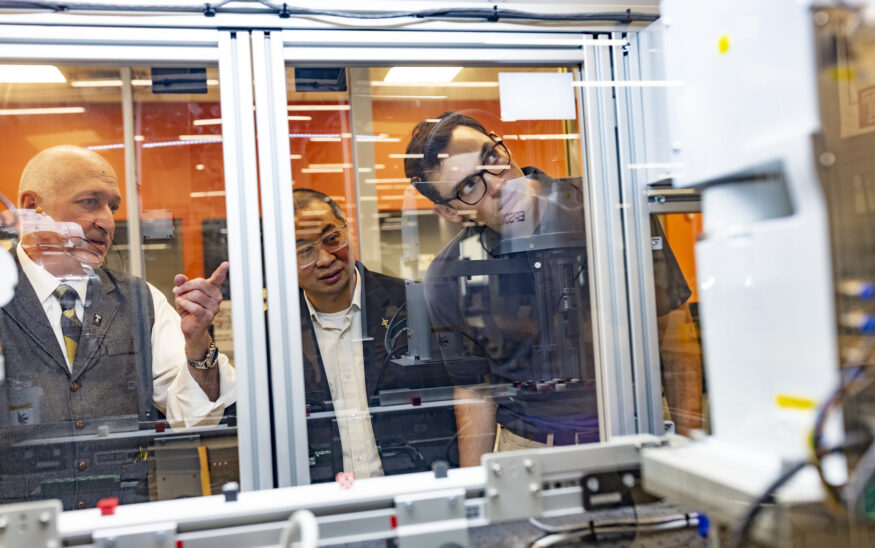
Stephen Maund, left, and Li Bai, center, are leading the new partnership between Temple and Demco Automation. Kyle McGinley, right, is a student who will be involved in the research. PHOTO/RYAN S. BRANDENBERG
Temple University working with Quakertown manufacturer to improve robotic manufacturing
Stacy Wescoe//August 18, 2026//


Temple University and Quakertown-based Demco Automation have launched a partnership to explore how AI can make custom robotic manufacturing systems more affordable and accessible for Pennsylvania businesses.
The project received $69,530 from Pennsylvania’s Department of Community and Economic Development through its Manufacturing PA Innovation Program, which pairs Pennsylvania graduate and undergraduate students with local manufacturers to develop new technologies and advance innovation statewide.
The grant is going to the Temple College of Engineering and Demco Automation, which is an alumni-owned business, to explore how AI can help engineers design and build automated manufacturing systems for Pennsylvania businesses.
According to organizers, the work will bring together Temple engineering students and Demco engineers to develop AI tools that streamline the design of robotic manufacturing cells tailored specifically for a business’ needs. These manufacturing cells perform tasks that are impossible, inefficient or dangerous for human workers.
Li Bai, professor of electrical and computer engineering at Temple, said the work is needed because of how rapidly technology is changing in the robotic engineering field.
“Today the modern manufacturing process is very complicated,” Bai said. “Much isn’t taught in any classroom and isn’t in textbooks.”
He said by using AI to record innovations in the field, it can help engineering students learn the latest techniques.
It will help create a new curriculum that will train future Temple engineering students. This will help Temple engineering graduates stay competitive in manufacturing industry jobs.
The initiative is also expected to help regional businesses remain competitive through advanced automation by providing support for engineers working in the field.
For decades, globalization and lower labor costs overseas have put pressure on American manufacturers, especially small businesses, said Stephen Maund, president and CEO of Demco and a 1999 graduate of the College of Engineering.
He said staying ahead on the latest efficiencies and technologies can be difficult.
“Many big corporations can do it, but in Pennsylvania we have a lot of small and medium manufacturers who can’t,” Maund said.
This work will provide information that will help those manufacturers innovate more efficiently, while still making sure an engineer is making the final decision.
“AI and automation really go hand-in-hand,” said Maund. “Utilizing AI in custom automation applications and rapidly deploying automation tailored specifically for a business or factory can be a true competitive advantage.”
Demco Automation provides custom automated robotics and manufacturing systems for various industries ranging from pharmaceuticals and medical devices to electronics, batteries and consumer products. Their systems perform manufacturing tasks that would be impossible, inefficient or dangerous for human workers.
Maund also donated equipment and staff mentorship, bringing Demco’s donation value to over $94,000 and the total initiative value to over $163,000.
The initiative was one of 47 projects across Pennsylvania to receive funding through the DCED program.
“Steve is a dedicated alum who has been on our Board of Visitors for many years, and he understands that robotic technology will be a big driving force to keep manufacturing happening in Pennsylvania,” said Bai, who is leading Temple’s side of the partnership.
Beyond its impact on Temple students, the school said the initiative will also benefit Pennsylvania businesses with manufacturing needs.
Automated manufacturing is key to maintaining a manufacturing presence in the country and Pennsylvania, Maund said.
“There’s just no way that manufacturing would be competitive without having the automated manufacturing option available to various companies, especially in advanced technology sectors,” said Maund. He added that the initiative will also impact the regional economy by adding jobs and increasing the manufacturing presence.