Sign In
Upcoming Event
 Free Newsletter

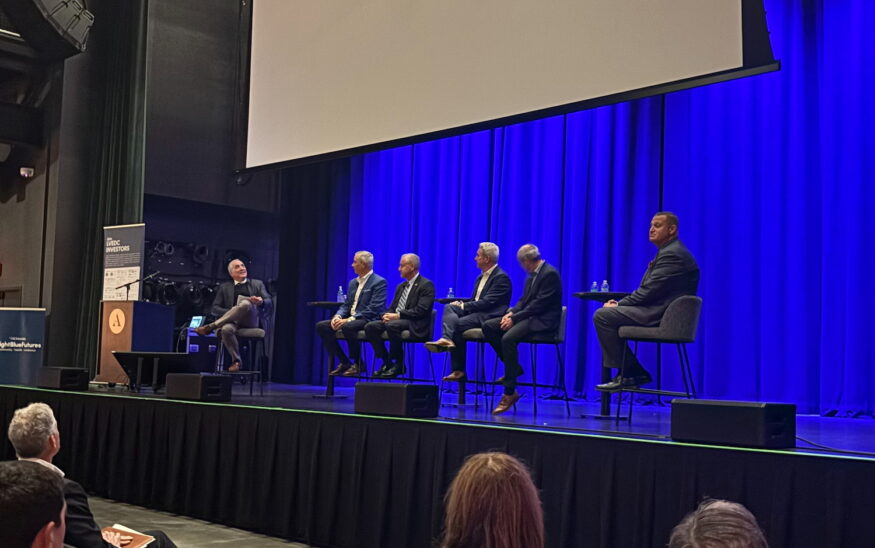
From left: Don Cunningham, president and CEO of the Lehigh Valley Economic Development Corporation holds a panel discussion with Brian Donlon, vice president and general manager of sales operations for Lutron Electronics; David Hartzell, Sr., president and CEO of Mack Defense; Richard Reynolds, president of medical systems operations for Olympus Corporation of the Americas; Thomas Ripsam, president and CEO of C.F. Martin & Co.; and Peter Ruggiero, president and CEO of Crayola. PHOTO/STACY WESCOE
LVEDC: Lehigh Valley remains hub for major manufacturers
Stacy Wescoe//November 12, 2025//


“Manufacturing is in our blood.” That was the message of the Lehigh Valley Economic Development Corporation Fall Signature Event, which focused on making products and making places.
Speaking at the Archer Music Hall in Downtown Allentown, where the event was held, LVEDC President and CEO Don Cunningham noted that the Lehigh Valley has been a hub for manufacturing since before the United States was a country, with multiple industrial sites dating back to before the revolutionary war.
Today, he said the Lehigh Valley has a gross domestic product of more than $9 billion, making it one of the top 15 manufacturing centers in the U.S., despite its relatively small size.
He noted that manufacturing is 16% of the region’s economy and is the top economic sector.
“We still make things in the Lehigh Valley, and we’re proud of that,” said Cunningham.
In fact, the LVEDC is going big with its promotion of the area’s manufacturing scene with a billboard campaign touting products that are “Made in the Lehigh Valley.”
The year-long campaign began Nov. 3 with Crayola, which has been making its iconic crayons here since 1903, and will expand to include Freshpet, Mack Trucks, Martin Guitar, and more Lehigh Valley companies.
The digital displays, provided by Adams Outdoor Advertising, are located on Route 22 and Interstate 78.
And while the Lehigh Valley is home to many interesting and iconic products, some of the stories about how they began in the Lehigh Valley are almost as interesting, with companies being drawn to the region for reasons ranging from love and resources to quality of life.
Speaking during a panel discussion at the event, Brian Donlon, vice president and general manager of sales operations at Lutron Electronics talked about how the company’s founder was the inventor of the dimmable light switch.
“It was designed to make spaces more beautiful, more comfortable and energy efficient,” Donlon said.
Invented in New York, the company moved to the Lehigh Valley after the founder met his wife and decided to relocate.
Crayola came to the Lehigh Valley for its natural resources, said Peter Ruggiero, president and CEO of the company.
Originally a chemical manufacturer, the founders became very wealthy and decided to do something for the community by getting into educational products.
The nearby slate resources allowed them to manufacture slate pencils and tablets and chalk, which eventually led to their crayon and art product empire.
Thomas Ripsam, president and CEO of C.F. Martin & Co., said the company began six generations ago in Germany, when the family was making cabinets. Christian Martin decided he wanted to make guitars, but because of restrictions from the guitar maker’s guild where he lived, he decided to move to the U.S. and eventually settled in Nazareth.
Mack Trucks also came to the Lehigh Valley from New York in the early 1900s. It moved to Allentown in 1905, making some of its first trucks for the military during World War 1.
Because of the toughness of the trucks, David Hartzell, Sr., president and CEO of Mack Defense, said soldiers began referring to the trucks as bulldogs, and the bulldog remains the company’s mascot to this day.
In 2011, Mack Defense was spun off as a separate division of Mack and makes military versions of its trucks right in Allentown.
One of the newer globally known companies in the Lehigh Valley started out 100 years ago in Japan. Olympus started making microscopes and then cameras.
In the 1950s, it developed the world’s first endoscope.
Olympus opened its American Headquarters in the Lehigh Valley in 2006, which Cunningham called one of the most significant corporate locations in his lifetime.
Today, Olympus Corporation of the Americas, concentrates on endoscopes and other medical devices, having sold off its camera division.
Richard Reynolds, president of the medical systems group for Olympus, said the company chose Center Valley because of the quality of life it would offer to the people who would work there.
“We needed good distribution to key markets and major metropolitian areas,” Reynolds said. “But the one main thing we were looking for was to put down roots …somewhere we know our employees would enjoy living.”