Sign In
Upcoming Event
 Free Newsletter


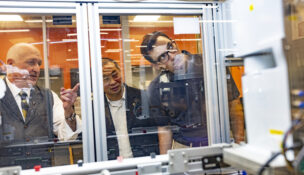
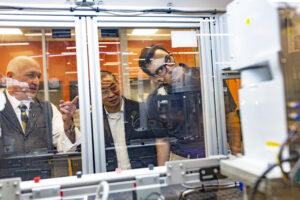
TOYOTA: A group of manufacturing leaders from Lehigh Valley visited the Toyota plant in Louisville, Kentucky to see lean culture in action – PHOTO/MRC STAFF
MRC leads tour of Toyota plant to see lean culture in action
Cris Collingwood//October 23, 2023//


A group of 28 manufacturing leaders from Lehigh Valley spent three days at the Toyota manufacturing plant in Louisville, Kentucky recently to learn about lean culture.
Led by Manufacturers Resource Center (MRC) in Allentown, the group was guided by Mike Hoseus, co-author of Toyota Culture: The Heart and Soul of the Toyota Way.
Gene Kaschak, vice president, Continuous Improvement and Leadership Development Strategy at MRC, said the trip was intended to show area manufacturers where lean culture began and how to incorporate it into their operations.
The trip was a culmination of the training MRC does locally.

“We define lean culture as daily problem solving that allows companies to achieve customer expectations,” Kaschak, who teaches Foundations of Lean Certification locally, said.
“Our curriculum is based on their methods,” he said. “The 4P model emphasizes people, process, purpose and problem solving, which improves quality and on time delivery.”
The method looks at how to increase the value to the customer, how to create the culture the company wants and how to empower the team to be vocal to identify problem points and overcome challenges, he said.
Diane Lewis, MRC vice president, said the method empowers everyone in the company to be better.
“It is based on servant leadership,” Lewis said. “It teaches leaders to be there for their people, not the other way around.”
Lewis explained that leaders offer tools and knowledge to find solutions to problems in the manufacturing process.
“It creates an environment where it is safe for those doing the work to offer suggestions to improve how they do their job,” she said.
By way of example, Lewis said if an employee sees a scratch on a car, they stop the process immediately to fix it. Even if it was an accident, employees are empowered to find out how the accident happened without repercussions.
“They find the root cause of the problem and share it with everyone, so no one makes process errors,” Kaschak said.
An accident doesn’t mean the employee was doing something wrong, Lewis explained. It could have been the car was positioned wrong or they needed a different tool or maybe even the stool they were sitting on wasn’t high enough.
“If you can prevent mistakes, the cost of a quality product is lower,” she said.
The lean culture model reduces costs, increases customer satisfaction, increases delivery time and reduces operator safety, Kaschak said.
“Many times, manufacturers are firefighting through solutions to problems,” Kaschak said. “But those problems often come back. We use an eight-step plan that has been proven effective.”
That process is based on Toyota’s method of plan, do, check and act, which is the skeleton of the eight steps, he said.
“If it doesn’t work, you choose another method and train all employees on it,” Kaschak said.
MRC brings Hoseus, who was one of the first employees at the nine million square foot Toyota facility, to Allentown for three days each year. It was through that connection that this tour was possible.
He is the executive director for the Center for Quality People & Organizations (CQPO), an organization developed in 1999 as a vision of Toyota Motor Manufacturing to share Lean Quality philosophy and human resource practices with education, business, and community organizations.
“Not anyone can go to Toyota,” Lewis said. “This was a private tour that was great to provide for our manufacturers. They told us about their successes, struggles and we could ask questions.”
Chantal Warner, supply chain product engineer, who works in the Global Process Improvement department, Lutron Electronics Co. Inc., said, she is grateful to have been able to walk through Toyota Motor Manufacturing Kentucky, Aichi Forge and Hitachi Astemo and go to the gemba.
The trip showed her the company needs to ensure there is a system in place to support the behaviors and cultures it wants to develop for employees.
“Without the system aligned to our guiding principles, there is no way to drive the culture to the ideal state,” Warner said. “An aligned system will then allow us to select the correct tools needed to achieve the results we desire.”
Warner said after returning from the trip she has begun reviewing the systems Lutron has in place and is asking questions to ensure the expectations around the company’s processes are clear.
“I am currently working on a documentation to capture these expectations to help coach and guide the leaders of our facilities,” she said. “The feedback I have received thus far has been helpful and really helped to show the team the gaps we have in our process. I aim to continue to develop this system and try this at one of our facilities.”
One of the most noteworthy points for Warner was the discussions around problem solving.
“In our discussions, we reviewed the purpose of standard work as an opportunity to solve problems. Standard work is not simply a document to hold people
accountable to,” she said. “We should be using the documented standard work to measure against, to determine current state, our actual condition now.”
Kaschak said the process of lean culture is one that needs to be continually practiced. Those that do, he said, are the successful ones.
“This helps retain employees,” he said. “Young people want to be involved in the process.”
While the concept might sound easy, Kaschak said it takes time and practice.
“You will stumble but as long as you have the three elements in mind, you will succeed,” he added.
Lewis said the method is taught at MRC several times a year. The six-day course teaches the fundamentals of the method and how to put them into practice.
MRC has a factory simulator on site so participants can learn in a chaotic environment.
“This is a realistic setting where they receive orders and produce tangible products,” Lewis said. “We coach them through problems so they can deliver a quality product the customer expects.”
MRC also runs a Master Lean Certification once a year that runs for 12 days. Kaschak said his team goes on site to practice the methodology with real problems and opportunities.
“This allows visibility into real problems,” he said. And while it benefits the host, it benefits the participants as well because they see it in action in real time.
“This allows participants to think outside the box to advance their journey,” Lewis said.