Sign In
Upcoming Event
 Free Newsletter

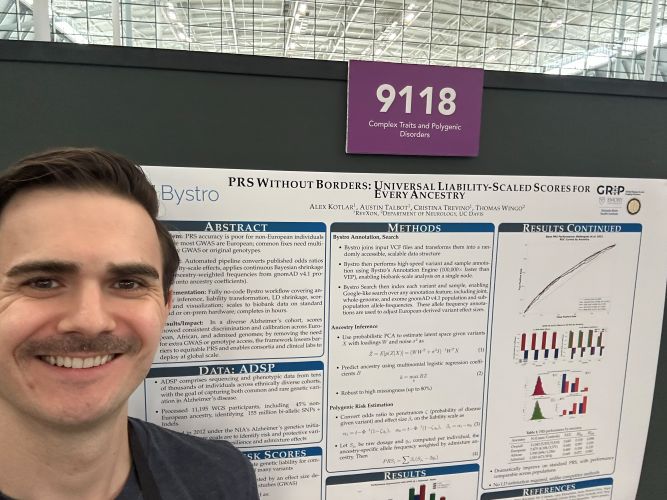
Bystro founder Alex Kotlar said his company’s platform analyzes genetic data to predict disease risk, treatment response, and outcomes before symptoms appear. PHOTO/PROVIDED BY BYSTRO AI
Predictive AI next phase in healthcare
Ed Gruver//May 12, 2026//


U.S. hospitals employ artificial intelligence (AI) in a variety of ways.
By summarizing patient visits, flagging urgent findings in imaging, and identifying patients at risk, AI supports physicians. It catches risks and improves efficiency, but it remains reactive. In some ways, Healthcare AI as it looks today is like the early versions of self-driving cars. While AI can assist, a human remains firmly in control.
In healthcare, the next phase is predictive AI, and that’s where Bystro AI comes in.
Rather than focus on medical records, Bystro AI founder Alex Kotlar and his Boston-based company’s platform analyze genetic data — the blueprint of one’s health — to predict disease risk, treatment response, and outcomes before symptoms even appear.
According to the company, it’s the difference between looking in the rearview mirror and looking ahead to see what’s coming down the road. Kotlar said his company’s approach grounds AI in real biological data, allowing clinicians and researchers to run complex genomic analysis using simple, natural language and generate reproducible, research-grade insights in seconds.
“Bystro AI started as a ‘ChatGPT for your DNA‘,” said Kotlar. “It’s a conversational AI platform that allows individuals and researchers to interact directly with genetic data—whether from large clinical datasets or consumer sources like 23andMe—and receive answers grounded in real biology and peer-reviewed science. The platform has also seen strong adoption among users looking for clear, accessible explanations of complex research as it relates to their own health questions.”
Kotlar noted that what sets Bystro apart is that it doesn’t simply generate responses based on language patterns.
“It’s built on grounded agentic AI, which anchors answers in actual genomic data,” Kotlar stated. “That means it’s not guessing, but interpreting. The broader goal is to transform highly complex genetic information into insights that are understandable, actionable, and ultimately predictive as opposed to reactive.”
Kotlar called Healthcare AI’s current phase its “early Tesla” phase.
“Think back to the early days of Tesla and self-driving cars,” he said. “The promise was massive, but the technology was inconsistent, sometimes unreliable, and still very much in a learning phase. Healthcare AI is in that exact moment right now.
“Hospitals are deploying AI tools, but most are narrow, reactive, and heavily supervised. They’re good at identifying risk after the fact … like flagging a patient who might deteriorate but they’re not yet great at predicting outcomes before symptoms appear. We’re still in the “driver assist” phase of AI in medicine, not full autonomy. And just like with Tesla, the next leap forward will come from better data and smarter systems. Not just more AI.”
Kotlar identified what’s missing from today’s hospital AI systems.
“The biggest gap is that most hospital AI is built on electronic medical records (EMRs), which are inherently backward-looking,” he said. “EMRs give you the past, like what already happened, what symptoms showed up, and what treatments were given. But they don’t tell you what’s going to happen next.
“What’s missing is a foundational layer of biology … specifically genetics. Without that, AI is making educated guesses based on history, not truly understanding the patient at a molecular level.”
Kotlar said there’s also a trust issue regarding AI.
“Many current AI tools operate like black boxes, which makes clinicians hesitant to rely on them for critical decisions,” he said. “Systems like Bystro aim to solve that by making outputs interpretable and evidence backed.”
Genetics play a role in healthcare, Kotlar stated.
“Genetics flips healthcare from reactive to predictive,” he said. “Instead of waiting for symptoms to appear, genetic data allows you to understand things like disease risk, how a patient will respond to specific treatments, and underlying causes, not just symptoms. It’s the difference between reading a patient’s medical history and reading their biological blueprint.
“When AI is grounded in genetics, it can move beyond pattern recognition and start making biologically informed insights. That’s a massive shift from ‘this looks like other cases’ to ‘this is what’s likely to happen to you.’”
The question is, what does this mean for patients in the next 3–5 years?
“In the near future, patients won’t just Google symptoms, or ask WebMD, they’ll be able to ‘talk to’ their own biology,” said Kotlar. “Or as we like to say, ‘Ask Bystro.’ This means faster, more personalized answers about health risks, earlier detection of conditions before they become serious, more precise treatments tailored to their genetic profile, and less trial-and-error in medicine.
“We’re moving toward a world where healthcare is proactive instead of reactive. Where the system helps prevent disease, not just treat it.”