Sign In
Upcoming Event
 Free Newsletter

LeadingAge PA reports on crisis in aging services
Rochelle A. Shenk//May 8, 2026
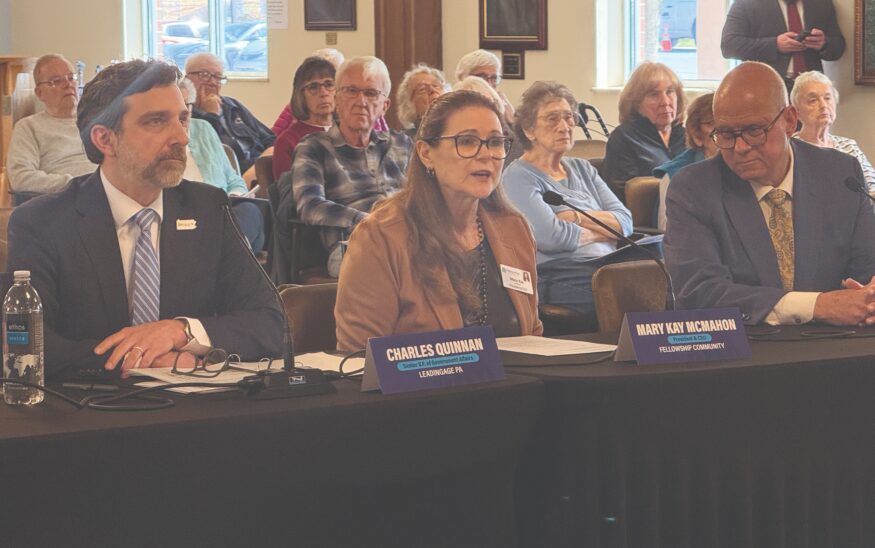
Chuck Quinnan, of LeadingAge PA, and Mary Kay McMahon, of Fellowship Community in Whitehall, testify before the PA Senate Democratic Policy Committee for its public hearing on Nursing Home Stability and Costs. PHOTO COURTESY OF LEADINGAGE PA
LeadingAge PA reports on crisis in aging services
Rochelle A. Shenk//May 8, 2026//


 Listen to this article
<ul>
<li>LeadingAge PA reports $6.2 billion economic impact of senior living</li>
<li>49% of nursing homes report declined hospital admissions</li>
<li>LeadingAge PA requests $274 million investment to stabilize Medicaid funding</li>
</ul>
LeadingAge PA, an association of elder care providers, recently released a report on the “growing crisis in Pennsylvania’s aging services sector”. Senior living has a $6.2 billion impact on the state’s economy, and 24,500 jobs are directly supported by senior living.
Key findings in the report indicate that 49% of nursing homes have declined hospital admissions in the Last 90 days (as of Jan. 2026); 68% report more than five open direct care positions; and Inadequate Medicaid funding is forcing closures or reduced services. Additionally, the state’s population of residents over age 84 is projected to triple by 2050.
“Pennsylvania’s capacity to care for its older adults is shrinking, while the aging population is growing,” said Chuck Quinnan, LeadingAge PA senior vice president and chief government affairs officer. “The major part of the crisis is due to inadequate Medicaid reimbursement to care providers. Coupled with an ongoing workforce shortage, it’s created an access to care crisis. And that crisis is definitely here; we’re not approaching the cliff, we’re already over the cliff.”
Jonathan Hollinger, president and CEO of Pleasant View Communities, Manheim, said the state’s Medicaid reimbursement model has been flat funded for awhile.
“What we’re seeing is Medicaid reimbursement is about half of private pay,” he said.
Quinnan said one of the drivers in the Medicaid reimbursement decline is the Budget Adjustment Factor, or BAF, which is used to calculate the percentage of reimbursement to nursing homes. He pointed out that the BAF is adjusted quarterly. For the first quarter of this year, the BAF is 80%; that means providers are losing $63 per day due to the BAF. Quinnan said after no increase in funding during the current fiscal year, LeadingAge PA is asking the state to establish an 84% BAF floor for the 2026-27 fiscal year. That would translate to a $274 million investment in Medicaid and stabilize nursing home care.
Quinnan testified April 9 before the PA Senate Democratic Policy Committee for its public hearing on Nursing Home Stability and Costs. Mary Kay McMahon, president & CEO of Fellowship Community in Whitehall, also testified at the hearing.
“Although Fellowship Community has not yet been forced to cap admissions or close beds, the challenges we face are real and increasingly difficult to manage. The root cause of this crisis is the persistent underfunding and unpredictability of Medicaid reimbursement,” McMahon said during the hearing
She said on average, 45 to 50 percent of Fellowship Community’s skilled nursing residents rely on Medicaid, and Medicaid reimbursement does not consistently keep pace with actual costs. The result is a significant per-resident, per-day funding shortfall of $125.62.
“We continue to operate this service because of our mission and our commitment to the community, but doing so is becoming increasingly difficult,” McMahon said, “At a minimum, the Commonwealth should fully fund Medicaid rates as calculated and avoid the use of across-the-board reductions that make long-term planning nearly impossible for providers.”
“We are committed to providing charitable care to residents who outlive their resources, but we cannot sustain this commitment without appropriate support from the Commonwealth,” she added.
Hollinger said that, at Pleasant View, about 46% of skilled nursing residents are on Medicaid assistance.
“The challenge is Medicaid reimbursement has not kept up with rising costs; the BAF is not a sustainable model,” Hollinger said.
He said Pleasant View provides $3.5 million annually in benevolent care. While the continuing care retirement community does have a benevolent fund and some of the Medicaid gap cost is made up by private pay residents, he said the majority of the Medicare funding gap is paid for via entrance fees from new residents entering Pleasant View’s continuum of care.
Quinnan said that since 2020, 37 nursing homes have closed, and the state has lost 4,300 certified nursing home beds.
“Our members are mission led and mission driven, but 70% are having to decline hospital referrals,” Quinnan said.
McMahon said that even with stable Medicaid funding, high quality care cannot be delivered without a stable workforce. She said Pennsylvania is currently experiencing a significant healthcare workforce shortage; between 2020 and 2023, the state’s active Nurse Aide Registry declined 15 percent, representing a loss of about 15,000 workers.
“If our collective goal is quality care, [state] policies should focus on strengthening the workforce pipeline, ensuring sustainable funding and allowing providers reasonable flexibility to adjust staffing based on resident needs rather than rigid formulas alone,” she said.
“There’s a Boomer wave coming in of people needing care. There’s also a shortage of caregivers, so we’re paying more for caregivers,” Hollinger explained. He said Pleasant View has 133 certified skilled care beds, but has taken some offline and is now at 92 beds.
“We have more than enough referrals from hospitals and are often filled, but we don’t have the staff to cover all the beds, so we’ve reduced our number of beds,” he said.
Hollinger said Pleasant View is exploring options to provide support that would allow residents to “age in place” and support independence at home on Pleasant View’s campus longer rather than transition to a higher level of care. One of these measures is adding care navigators to help connect residents with services. Another measure is reducing the minimum number of hours for a home care aide visit from two hours to 10 minutes.
“Some people may only need with daily living activities such as dressing. So, we’ve made it possible for them to use a home aide for a short period of time, and we’ve done it in ways to make it affordable–it’s $10 for 10 minutes,” Hollinger said.
Pleasant View is also reimagining the transition for its residents from hospital to home. Hollinger said there is a little margin in its personal care area, so some personal care aides have been trained as home care aides. It means they can provide assistance to residents in their own home so they don’t need to skilled care. He said not every resident’s medical needs allow for this direct from hospital to home transition, but for those that do it “allows people to thrive in their home environment”.